HOA Mosquito Control for South Florida Communities
County spray programs don't treat private HOA property. Shared retention ponds, community lakes, and common area landscaping are breeding sources that individual homeowners can't address, but your board can. We provide written proposals for HOA common area treatment, service documentation for board records, and programs that coordinate with your landscape vendor.
Serving Boca Raton, Fort Lauderdale, Pompano Beach, Coral Springs, Parkland, and 28+ communities in Broward and Palm Beach County.
Broward County and Palm Beach County mosquito control programs spray public roads and parks, not private HOA property. Your shared retention ponds, community lakes, and common area landscaping are continuous breeding sources that sit in a treatment gap between county programs and what individual homeowners can do on their own lots.
Why HOA Communities Struggle More Than Individual Properties
The features that make South Florida HOA communities attractive (lakes, ponds, lush common landscaping) are also continuous mosquito breeding infrastructure:
Breed mosquitoes even when well-maintained. Grass carp and aeration improve water quality but don't eliminate mosquito production from shallow, vegetated pond edges. These are the highest-volume breeding sources in most HOA communities.
Dense ornamental shrubs, tree lines, and mulched borders provide ideal daytime resting habitat for adult mosquitoes. Large amounts of common area vegetation mean large amounts of resting habitat, all untreated unless the board contracts for it.
Community irrigation systems maintain moist conditions in common areas through the dry season, extending the effective breeding period beyond what rain alone would support.
Some homes treated, many not. Gaps in residential coverage let populations persist in private lots and spread back into treated areas, limiting results for everyone, including homeowners who do have individual programs.
Many Broward and Palm Beach County communities back to county-maintained canals. Canal banks breed year-round. These fall between county spray program coverage and HOA property boundaries, a persistent untreated source.
What We Treat in HOA Communities
Every community is different. We walk the property and map treatment zones before quoting. Common treatment areas include:
Barrier spray along shallow vegetated margins where production is highest. Most impactful single treatment in most communities.
High-visibility areas. Treating entrance landscaping reduces resident and visitor mosquito contact at first impression points.
Pool deck perimeters, clubhouse surrounds, picnic pavilions, and playground areas, high-traffic zones where mosquito activity most directly affects resident satisfaction.
The border between private lots and HOA property. Treating the HOA side reduces reinfestation pressure on private lots from adjacent untreated resting habitat.
Walking and cycling paths through landscaped corridors are high-exposure points for active residents. Trail-edge vegetation is a priority treatment zone.
For pool decks and clubhouse outdoor areas requiring consistent evening protection, automated misting systems run on schedule and trigger remotely before HOA events.
Community Types with the Highest Mosquito Pressure
HOA lakes are the most consistent high-volume breeding source. Even actively maintained lakes produce sustained pressure from shallow vegetated edges.
Golf course irrigation runs year-round. Fairway rough and perimeter areas create large breeding zones adjacent to private lots, usually outside HOA control but adjacent to community property.
Canal banks breed year-round. HOA property adjacent to county canals sees sustained pressure that private lot treatment alone can't resolve.
Everglades proximity means inbound mosquito migration from preserve habitat during wet season. Community perimeter treatment is the most effective available intervention.
Service Documentation for HOA Boards
We understand that HOA boards need documentation for resident communication, insurance compliance, and vendor accountability. We provide:
HOA Board or Property Manager?
We provide a free community walk-through and written proposal with specific treatment zones and pricing, structured for board presentation. Reach us through our Contact us or call 561-443-3333 to schedule. We can also coordinate directly with your landscape maintenance vendor.
Frequently Asked Questions
Can an HOA board contract mosquito control for common areas separately from individual homeowner programs?
Yes. HOA boards can contract for treatment of common areas, retention pond edges, perimeter landscaping, and community amenity zones independently of what individual homeowners do on their own lots. We provide written proposals with specific treatment zones, service frequency, and pricing structured for board presentation and budget approval. Individual homeowner programs and HOA board programs can run simultaneously on coordinated schedules.
Does county mosquito control spray private HOA property?
No. Broward County Mosquito Control and Palm Beach County Mosquito Control focus on public rights-of-way and public parklands. They do not treat private HOA retention ponds, community lakes, or common area landscaping. Private HOA property requires a licensed private pest control operator, that's the gap we fill.
What does mosquito control treatment of HOA common areas include?
A typical HOA common area program treats: retention pond and lake edges (the most important source: shallow vegetated margins breed heavily), common area perimeter landscaping and tree lines, entrance features and monument landscaping, community amenity areas (pool deck perimeters, clubhouse surrounds, picnic pavilions, playground perimeters), and fitness trail corridors. We walk the property, map specific zones, and build a proposal around your community's actual layout.
What records and documentation do you provide for HOA boards?
We provide service logs for every visit documenting date, time, treated zones, and product applied. Records are maintained and available for board review at any time. We can also provide a summary service report for board meetings and insurance documentation if required. All work is performed under FL License JB313837 with full liability insurance, documentation available on request for HOA compliance requirements.
How do you coordinate scheduling with the HOA's landscape maintenance vendor?
We can coordinate directly with your landscaping vendor to sequence treatments: typically, barrier spray is most effective when applied to foliage that is not freshly cut or blown, so we schedule after a mowing cycle rather than the same day. We communicate directly with your landscape contact to avoid conflicts and maximize treatment effectiveness. This is a normal part of how we operate in community settings.
How is treatment frequency for HOA common areas different from residential service?
We treat community common areas on the same 10 to 17 day schedule as residential properties, not monthly. Monthly service cannot keep pace with South Florida's mosquito reproductive cycle, particularly for properties adjacent to retention ponds. Our rain-resistant MPB formula with Rain Shield polymer maintains effectiveness through South Florida's daily afternoon storms. This is one of the key differentiators to verify when comparing vendors: many landscaping companies that offer 'mosquito spray' operate on monthly schedules with no rain-resistant carrier.
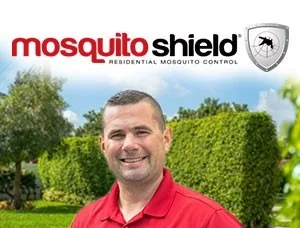
After nearly two decades in corporate finance (most of it at Chico's FAS, where he oversaw operations and finance for 1,000+ retail locations across the US and Canada) Eric Vincent earned his MBA from Rollins College and made a deliberate pivot into pest control, completing his Pest Control Technology degree at the University of Florida while building Mosquito Shield of Boca and Fort Lauderdale from the ground up. He holds five Florida state licenses including Certified Pest Control Operator (JF341961) and Public Health licensee (PH340549), and is currently partnered with Arkion Life Sciences on next-generation all-natural mosquito control research.