
Mosquitoes bite cats, and infected Culex bites can transmit heartworm. Unlike dogs, there is no approved heartworm treatment for cats: prevention is the only strategy. Indoor cats in South Florida are not reliably protected. Ask your veterinarian about year-round feline heartworm prevention.
Most cat owners know that dogs get heartworm. Fewer know that cats do too, and that feline heartworm is in some ways more dangerous because there is no treatment once infection is established. South Florida's year-round Culex quinquefasciatus population makes this a year-round risk for every cat in Broward and Palm Beach counties, regardless of whether they go outside.
Feline vs. Canine Heartworm: Key Differences
| Factor | Dogs | Cats |
|---|---|---|
| Typical worm burden | 5 to 15+ adult worms | 1 to 3 adult worms (larvae often die before maturity) |
| Adult worm lifespan | 5 to 7 years | 2 to 4 years (fewer complete the cycle) |
| Symptoms | Coughing, exercise intolerance, weight loss | Coughing, vomiting, respiratory distress, often misdiagnosed as asthma |
| Approved treatment? | Yes: melarsomine protocol | No: no approved treatment |
| Prevention options | Multiple monthly products | Monthly preventives (ivermectin-based), consult vet |
| Diagnostic testing | Antigen test (detects adult worm protein) | Antigen + antibody testing (antigen can be false negative in cats) |
| Indoor risk | Lower but not zero | 25 to 27% of infected cats reported as indoor-only |
âš Important: Pyrethroids Are Dangerous for Cats
Permethrin, the active ingredient in many mosquito control products and some dog flea/tick products, is severely toxic to cats. Cats lack the liver enzyme (glucuronyl transferase) to metabolize pyrethroids, causing neurological toxicity that can be fatal.
Ready to reclaim your yard? Free assessment, no contracts, plant-oil formula.
Frequently Asked Questions
Do mosquitoes bite cats?
Yes (mosquitoes bite cats. Cats are less preferred hosts than dogs or humans (mosquitoes tend to prefer larger mammals with higher CO2 output), but they are absolutely bitten) particularly outdoor cats and indoor-outdoor cats in South Florida. Mosquitoes find exposed skin around a cat's ears, nose, and areas with thinner fur. Indoor cats can also be bitten by mosquitoes that enter the home, particularly in households where doors are frequently opened or screened areas have gaps.
Can cats get heartworm from mosquitoes?
Yes: cats can get heartworm (Dirofilaria immitis) from infected Culex quinquefasciatus mosquito bites. However, cats are atypical hosts for heartworm compared to dogs. Key differences: (1) Larvae have a much lower survival rate in cats, most infections produce 1 to 3 adult worms vs. the larger dog burdens. (2) Adult worms rarely complete full development in cats and often die before reaching reproductive maturity. (3) There is NO approved heartworm treatment for cats (unlike dogs, where treatment exists). (4) Despite smaller worm burdens, cats can develop heartworm-associated respiratory disease (HARD) from dying larvae: sometimes called 'feline asthma' or 'feline bronchitis' when the true cause is undiagnosed heartworm. In South Florida's year-round Culex environment, feline heartworm prevention is appropriate for both indoor and outdoor cats.
Should indoor cats be on heartworm prevention in Florida?
Yes, veterinary guidelines and the American Heartworm Society recommend heartworm prevention for indoor cats in South Florida, not just outdoor cats. The reason: indoor cats are not reliably protected from mosquito exposure. Studies have found that 25 to 27% of heartworm-positive cats were reported by their owners as 'indoor only.' Mosquitoes enter homes regularly through open doors, windows, and gaps around screens. In South Florida's year-round Culex environment, where any given mosquito bite carries a real (if small) risk of transmitting heartworm larvae: the modest cost of monthly feline heartworm prevention is justified for indoor and outdoor cats alike. Consult your veterinarian about appropriate feline heartworm prevention options.
What are the symptoms of heartworm in cats?
Feline heartworm symptoms are frequently misdiagnosed because they don't always resemble what's seen in dogs. Common signs include: coughing or wheezing (often attributed to asthma), rapid breathing, intermittent vomiting (sometimes unrelated to eating), lethargy, weight loss, and occasionally sudden death (from heartworm-associated respiratory complications). Because cats process heartworm differently, with fewer worms and erratic survival, symptoms can be acute and severe when larvae die in the pulmonary vasculature, causing inflammatory response. Many cats live with subclinical heartworm infection for years; others experience acute respiratory crisis. Periodic veterinary screening is the only reliable way to identify infection.
Is mosquito spray safe for cats?
This depends heavily on the product. Pyrethrins and pyrethroids (permethrin, bifenthrin): the active ingredients in most mosquito spray products, are significantly more toxic to cats than to dogs or humans. Permethrin toxicity in cats is a veterinary emergency, cats lack the liver enzyme to metabolize pyrethroids effectively. Mosquito Shield's treatment pairs the plant-based MPB blend (natural plant-derived oils) with a small amount of a targeted control product in the same class used in flea and tick treatments. Because cats are more sensitive to this product class than dogs, the guidance matters: keep cats off treated vegetation until surfaces are fully dry, about 30 minutes. Once dry, treated surfaces are the same low-exposure situation as a dried flea treatment. If you use any DIY mosquito product, verify that it is specifically labeled safe for cats: many standard formulas are not.
Can professional mosquito spray near the house hurt my indoor cat?
No, when applied correctly. Our treatment: a plant-oil MPB blend plus a small control product in the same class as flea and tick treatments, is applied to outdoor vegetation and surfaces, not interior living spaces. Cats are more sensitive to that product class than dogs, so timing matters: keep pets indoors during the application itself and for about 30 minutes after, while the formula is wet. Once treated vegetation is fully dry, residue contact from brushing past plants is a low-exposure situation, the same principle as a dried flea treatment. For customers concerned about sensitive cats (or cats with known respiratory conditions), we can discuss additional precautions. Never use pyrethroid-based mosquito spray products (standard bifenthrin/permethrin formulas) around cats. This includes many DIY products.
Barrier Spray for Cat Households
Plant-based MPB blend plus a small targeted control product. Keep cats off treated areas until fully dry, about 30 minutes. Effective against the Culex mosquitoes that transmit heartworm. FL License JB313837.
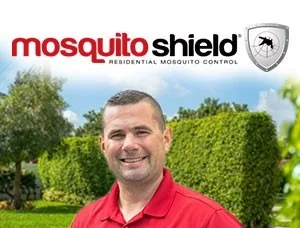
After nearly two decades in corporate finance (most of it at Chico's FAS, where he oversaw operations and finance for 1,000+ retail locations across the US and Canada) Eric Vincent earned his MBA from Rollins College and made a deliberate pivot into pest control, completing his Pest Control Technology degree at the University of Florida while building Mosquito Shield of Boca and Fort Lauderdale from the ground up. He holds five Florida state licenses including Certified Pest Control Operator (JF341961) and Public Health licensee (PH340549), and is currently partnered with Arkion Life Sciences on next-generation all-natural mosquito control research.