
In South Florida's climate, even the best barrier spray lasts 10 to 17 days before rain, UV, and heat degrade it. Monthly service leaves a 10 to 17 day gap per cycle where product has failed but the next visit hasn't come. That gap is where mosquito populations surge back.
Treatment Interval Comparison
| Interval | Type | In South Florida | Best For |
|---|---|---|---|
| Weekly | Premium / Event Shield | Continuous coverage | Pre-event, severe infestations, or commercial |
| Every 10 to 14 days | Biweekly (our standard) | Maximum overlap: no coverage gaps | Canal/lake frontage; Everglades-adjacent; heavy pressure |
| Every 21 days | 3-week interval | Some gap risk in wet season | Moderate pressure; inland suburban properties |
| Monthly (28 to 30 days) | Industry standard | 10 to 14 day gap in South FL conditions | Northern markets; mild pressure areas |
| Quarterly | Pest Shield (ants/roaches) | Not for mosquitoes | Perimeter pest (ants, palmetto bugs, spiders) |
Why South Florida Compresses Every Treatment Interval
Ready to reclaim your yard? Free assessment, no contracts, plant-oil formula.
Frequently Asked Questions
How long does professional mosquito spray last?
The duration of mosquito spray residual depends on the product formula and environmental conditions. In South Florida: (1) Standard pyrethroid-based sprays (permethrin, bifenthrin): 21 to 28 days under ideal conditions, but South Florida's intense UV, heat, and frequent rain degrade these to 10 to 14 effective days in practice. (2) Natural plant oil formulas (like the MPB blend we use): 10 to 17 days with Rain Shield (polymer surfactant) weatherization. Without Rain Shield weatherization, natural formulas may last only 7 to 10 days before Florida rain degrades them. (3) Synthetic products with microencapsulation: 21 to 30 days, but reduced efficacy in South Florida's rainfall. The key number is the point at which mosquito populations recover to pre-treatment levels, not the theoretical maximum residual. In South Florida's high-pressure environment with continuous breeding sources (canals, retention lakes, Everglades), the practical effective window for even the best products is 14 to 17 days before populations bounce back.
Why do companies offer monthly mosquito control if it doesn't work well in South Florida?
Monthly treatment intervals are the industry standard nationally, and they work reasonably well in many markets. The problem is South Florida's unique combination of factors that compress effective residual life: (1) Rainfall, South Florida averages 60+ inches per year, compared to 35 inches nationally. Even 'rainfast' products lose residual faster when challenged by heavy frequent rain. (2) UV intensity: South Florida's sun degrades surface-active pyrethroids significantly faster than northern climates. (3) Year-round continuous breeding, Northern markets get a full stop of mosquito breeding in winter, resetting populations to near zero. South Florida has no reset: populations stay active and breeding continues through January. In a northern state with mild mosquito pressure, a 28-day interval may maintain acceptable protection. In South Florida with canals, Everglades-adjacent floodwater, and year-round 85°F temps: monthly treatment leaves a 10 to 17 day gap where product has degraded but next treatment hasn't come. That gap is when populations surge.
Is biweekly (every 2 weeks) mosquito treatment necessary in South Florida?
Not every South Florida property needs biweekly service. The right interval depends on your property's mosquito pressure: High pressure (biweekly recommended): Properties with direct canal or lake frontage; properties near Intracoastal, Everglades, or freshwater retention ponds; properties with significant shaded vegetation; properties where evening outdoor use is frequent. Moderate pressure (every 3 weeks to monthly adequate): Interior suburban properties without direct water frontage; properties with limited vegetation and minimal container breeding sources. The default industry interval (monthly) is often insufficient for the highest-pressure South Florida properties. Our biweekly program is designed for maximum reduction, 80%+ by treatment 3 to 4, in high-pressure environments. We also offer every-3-week scheduling for moderate-pressure properties.
How many treatments before I notice a significant difference?
Most South Florida homeowners notice significant mosquito reduction after 2 to 3 treatments on a consistent schedule. The treatment schedule works like this: Treatment 1: Kills current adult population, breaks the breeding cycle in vegetation on the property. Immediate reduction noticed for 10 to 14 days. Treatment 2 (2 weeks later): Targets any adults that emerged from breeding sources since treatment 1. Compounds the first treatment's effect. Treatment 3 (4 weeks from start): Most properties reach 70 to 85% reduction at this point. Reduction is cumulative because we're continuously disrupting the breeding cycle. Treatment 4+ (ongoing): Maintains the reduced baseline. Without continuous treatment, populations recover. The compounding effect is why consistent interval service dramatically outperforms one-time or infrequent treatments.
Should I spray before or after it rains?
After rain is preferred over before, with an important timing window: spray 4 to 8 hours after rainfall stops, not during or immediately after. Here's why: (1) Rain flushes mosquito breeding sites and creates new standing water, adult mosquitoes emerge from fresh water sources 7 to 10 days after significant rainfall. Treating after rain targets the adults that are active following a rain event and residue weathers in before the next rainfall. (2) Our Rain Shield formula (polymer-based surfactant) is designed to bond product to leaf surfaces even through subsequent rain. Initial cure time is 15 to 30 minutes, once bonded, Rain Shield significantly improves waterproofness vs. untreated product. (3) Pre-rain spraying is less effective because even rain-resistant product is challenged more by rain during the initial 24-hour cure period. If timing is unavailable and treatment must happen before rain, treatment is still beneficial, just slightly less residual than post-rain timing.
Mosquito Shield, Biweekly Service With Rain Shield Technology
10 to 17 day residual with Rain Shield polymer. Applied every 10 to 14 days for continuous protection in South Florida's high-pressure environment. FL License JB313837. No contracts.
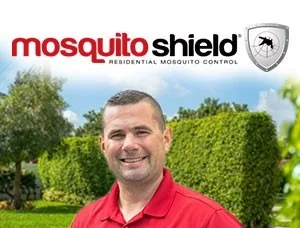
After nearly two decades in corporate finance (most of it at Chico's FAS, where he oversaw operations and finance for 1,000+ retail locations across the US and Canada) Eric Vincent earned his MBA from Rollins College and made a deliberate pivot into pest control, completing his Pest Control Technology degree at the University of Florida while building Mosquito Shield of Boca and Fort Lauderdale from the ground up. He holds five Florida state licenses including Certified Pest Control Operator (JF341961) and Public Health licensee (PH340549), and is currently partnered with Arkion Life Sciences on next-generation all-natural mosquito control research.