
Golf course lakes are the primary mosquito breeding source for your property. HOA treatment covers common areas but not your residential lot. Individual professional barrier spray applied biweekly to your property vegetation is the control layer that HOA programs don't provide, and the one that makes the actual difference for outdoor living on your lot.
Golf course water features (lakes, ponds, hazards)
Culex quinquefasciatus (West Nile vector), primary. Aedes in western communities.
Common areas only, not your private lot vegetation
June to October wet season; amplified vs. non-golf neighborhoods
Elevated for 60+ residents: golf communities trend older demographic
Individual property biweekly barrier spray
Ready to reclaim your yard? Free assessment, no contracts, plant-oil formula.
Frequently Asked Questions
Why do golf community residents in South Florida get worse mosquitoes than regular neighborhoods?
Golf community residents typically experience more intense mosquito pressure than non-golf residential neighborhoods for several compounding reasons: (1) Golf course lakes as primary breeding habitat: most South Florida golf courses are built around water hazards: lakes, ponds, retention areas, and drainage features. These water bodies are primary Culex quinquefasciatus breeding habitat: warm, organic-rich, slow-moving water that supports year-round mosquito breeding at high density. Golf course lakes are typically large enough to produce Culex populations that extend biting pressure throughout the entire development and beyond. (2) Golf course adjacency, residential lots in golf communities often back directly onto course vegetation, creating proximity to both water bodies and the dense vegetation adjacent to them where adult mosquitoes rest during daylight hours. Fairway-adjacent lots typically experience the most intense pressure. (3) Inadequate golf course treatment, golf courses primarily apply pesticides for turf management, not mosquito control. Many golf courses do treat their water hazards with Bti (larvicide) on some schedule, but the scale of water features and irregular treatment intervals means larvae continuously develop between treatments, sustaining adult Culex populations throughout the growing season. (4) Everglades adjacency: many South Florida golf communities are located in western areas near the Everglades, adding Aedes taeniorhynchus (salt marsh mosquito) migration pressure on top of the course's own Culex breeding.
Does HOA mosquito treatment cover my property in a golf community?
HOA-level mosquito treatment varies widely but almost never provides sufficient protection for individual residential lots: (1) HOA common area treatment only: most HOA mosquito treatments cover common areas: clubhouse grounds, parking areas, pool areas, and entry landscaping. These treatments may not include course-adjacent vegetation or individual lot vegetation where adult mosquitoes actually rest closest to your home. (2) Infrequent application: HOA-contracted services typically apply on a monthly or event-based schedule rather than the biweekly intervals that South Florida's UV, heat, and rain require to maintain effective residual coverage. Monthly application leaves a 10 to 17 day unprotected gap where product has degraded. (3) Not reaching your individual lot: even the best HOA treatment program doesn't treat the private vegetation on your residential lot: the shrubs, trees, and ornamental plants in your backyard where adult mosquitoes rest closest to your outdoor living areas. Individual property barrier spray is the necessary complement to any HOA-level treatment. (4) No control over golf course treatment: HOA programs don't control when, what, or how often the golf course itself applies mosquito control to its water features. The golf course is the primary source of mosquito pressure for most golf community residents, and most HOAs have no authority over course treatment decisions. (5) Bottom line: HOA treatment may reduce mosquito pressure in shared spaces, but it does not substitute for individual property barrier spray applied biweekly to the vegetation on and immediately around your own lot.
How does mosquito barrier spray work for golf community lots?
Professional barrier spray for golf community lots addresses the specific pressure sources these properties face: (1) Course-adjacent perimeter vegetation: the trees, hedges, and ornamental plants along your property boundary adjacent to the golf course are where adult mosquitoes migrate from the course onto your property and establish resting positions. Treating this perimeter vegetation with residual MPB barrier spray creates a kill zone where migrating mosquitoes die before reaching your outdoor living areas. (2) On-property resting vegetation: all the vegetation throughout your lot (shade trees, ornamental shrubs, hedges, palms, groundcover) serves as adult mosquito resting habitat. A thorough barrier spray application covers these resting areas with 10 to 17 day residual product, depleting the adult population between treatment visits. (3) Any on-property breeding sources: bromeliads, bird baths, ornamental water features, and other container-breeding sources in your landscaping contribute to Aedes aegypti pressure that is independent of the golf course. Barrier spray targets the vegetation adjacent to these sources. (4) The Kill/Mask/Repel mechanism: Mosquito Shield's MPB formula works on three levels: immediate contact kill of adults on treated surfaces, a chemical mask that prevents mosquitoes from locating CO2-emitting humans, and a repellent perimeter that discourages entry from surrounding untreated areas. This three-mechanism approach is why Mosquito Shield outperforms single-mechanism products in high-pressure environments like golf community lots.
Which South Florida golf communities does Mosquito Shield serve?
Mosquito Shield of Boca & Fort Lauderdale serves residential customers throughout our service territory's golf communities across Palm Beach and Broward Counties: (1) Boca Raton golf communities: Boca Country Club, Bocaire Country Club, Polo Club of Boca Raton, Boca West Country Club, Broken Sound Club, Boca Greens Country Club, and surrounding communities in western and central Boca. (2) Palm Beach County golf communities: Indian Spring Country Club, Hunters Run Country Club, Quail Ridge Country Club, City of Atlantis, and other Palm Beach County golf developments. (3) Broward County golf communities: Inverrary Country Club (Lauderhill), Eagle Trace (Coral Springs), Pine Island Ridge (Tamarac), Twin Lakes (Plantation), Weston Hills Country Club, Grand Palms (Pembroke Pines), Palm Aire Country Club (Pompano Beach), Deer Creek Country Club (Deerfield Beach), and adjacent communities throughout Broward County. (4) Individual residential service (we serve individual property owners within all of these communities, regardless of HOA coverage. Our service goes directly to your residential lot. We treat the vegetation on your property and your immediate perimeter) not the golf course itself. Contact us at 561-443-3333 for service in your specific golf community.
When is the worst mosquito season in South Florida golf communities?
Mosquito pressure in South Florida golf communities follows the same wet season pattern as the broader region, but with amplified intensity due to golf course water features: (1) June to October: Primary wet season peak. This is when golf course lake levels rise, organic content increases, and Culex breeding reaches peak intensity. Combined with Aedes aegypti container breeding in residential landscaping and Everglades migration events in western communities, June to October represents the period of most intense multi-species biting pressure in golf community lots. (2) August to September: Most intense period within the wet season. Multiple Culex generations have completed their breeding cycle by this point, and adult population levels reach their annual maximum. HOA and golf course treatment programs that operate on monthly schedules leave substantial unprotected gaps during this period. (3) Post-hurricane and major storm events: If a named storm increases water levels or expands flooding on or adjacent to the golf course, mosquito populations can surge dramatically within 7 to 10 days as emergency Aedes taeniorhynchus populations emerge from temporary flood areas. (4) Year-round baseline: Unlike northern golf communities, South Florida golf communities maintain a year-round baseline of Culex breeding in water features regardless of seasonal changes. November through May is lower-pressure than the wet season, but active Culex breeding continues throughout the year, particularly in western communities with lake-to-Everglades drainage connections.
Golf Communities We Serve
Individual Property Protection for Golf Community Residents
We treat your residential lot, not the golf course. Biweekly MPB barrier spray with Rain Shield creates sustained coverage on your property vegetation that HOA programs don't provide. FL License JB313837. No contracts.
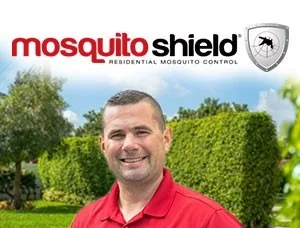
After nearly two decades in corporate finance (most of it at Chico's FAS, where he oversaw operations and finance for 1,000+ retail locations across the US and Canada) Eric Vincent earned his MBA from Rollins College and made a deliberate pivot into pest control, completing his Pest Control Technology degree at the University of Florida while building Mosquito Shield of Boca and Fort Lauderdale from the ground up. He holds five Florida state licenses including Certified Pest Control Operator (JF341961) and Public Health licensee (PH340549), and is currently partnered with Arkion Life Sciences on next-generation all-natural mosquito control research.