
Mosquito Control Around Koi Ponds and Water Features: What South Florida Homeowners Need to Know
Koi ponds, ornamental fountains, and water features breed mosquitoes in South Florida, but standard spray can harm fish. A licensed pest specialist explains fish-safe mosquito control options including Bti, In2Care, and how we treat the surrounding yard without contaminating your pond.
Koi Ponds and Mosquitoes: The Real Picture
Many homeowners assume their koi pond is a mosquito factory. The reality is more nuanced. A healthy koi pond with adequate stocking, good aeration, and regular maintenance is actually a mosquito control asset, koi actively eat larvae. The problems emerge when:
- The pump is off for any period (still water = breeding habitat)
- The pond has shallow marginal areas where larvae can develop in the vegetation zone
- There are separate water features (waterfall catch basins, bog filter areas) that don't receive fish pressure
- Power outages during storm season knock out circulation for days
- Organic debris accumulates and creates the nutrient-rich conditions Culex prefers
Even if your pond doesn't breed mosquitoes, the surrounding vegetation does. Adult Culex rest in dense groundcover, ornamental plantings, and shaded garden beds: the same landscape you've planted around your pond to make it beautiful. That resting habitat is exactly what barrier spray targets.
The Two-Part Approach: Water + Perimeter
In the Water: Bti Mosquito Dunks
Biological larvicide (Bti) that targets mosquito and midge larvae: 100% safe for koi, goldfish, and all aquatic life. One dunk lasts 30 days per 100 sq ft of surface. We can recommend placement and frequency based on your pond setup.
Around the Water: Barrier Spray
Our MPB formula treats the ornamental plantings, groundcover, and vegetation surrounding the pond, targeting resting adult mosquitoes without entering the water. We buffer pond edges and spray surrounding habitat where adults hide during the day.
Optional: In2Care Stations
Biocontrol stations that attract Aedes aegypti and contaminate them with a biological fungus and IGR. The mosquito then spreads the IGR to nearby water sources including pond margins. Particularly useful for properties with dense water feature areas.
What's Breeding Where: Diagnosing Your Water Feature
| Water Feature | Breeding Risk | Best Fix |
|---|---|---|
| Koi pond (stocked, aerated) | Low, koi eat larvae | Bti dunks as backup; maintain pump |
| Koi pond (understocked or still) | High, warm, organic water | Stock more koi; add aerator; Bti |
| Ornamental fountain (running) | Very low, moving water | Keep running; clean basin weekly |
| Ornamental fountain (off) | High, stagnant within 5 days | Run it or empty it; Bti if neither |
| Waterfall catch basin | Moderate, may have still zones | Check circulation; Bti in still areas |
| Bog filter / filter box | Moderate to high | Bti dunks monthly; cover openings |
| Birdbath | High, refilled weekly | Empty & refill every 3 days; or agitator |
| Decorative pot / bowl | High, no circulation | Empty weekly or fill with gravel |
Frequently Asked Questions
Will mosquito barrier spray harm my koi?+
Our barrier spray is not applied directly into water, and we maintain a safe buffer from pond edges. Koi can be sensitive to certain chemical classes (particularly pyrethroids at high concentrations), which is why we don't spray directly into or directly at the water surface. Our Mosquito Protection Blend is botanical-forward (citronella, rosemary, peppermint, castor oil, and geraniol) with a small EPA-registered control component selected for its safety profile near aquatic environments. We have treated hundreds of properties with ornamental ponds, koi ponds, and water features without incident.
My koi pond is the breeding source: what can I do about it?+
A properly maintained, aerated koi pond is actually less likely to breed mosquitoes than a neglected one (koi eat mosquito larvae. The problem occurs when: water circulation is poor or off (especially during power outages), there are shallow, still areas in the pond margins, or you have water features (waterfalls, bog filters) that create slow-flow areas where larvae can develop. Solutions include: keep the pump running continuously, especially at night; stock koi or goldfish (they eat larvae); use Bti (Bacillus thuringiensis israelensis) mosquito dunks) fish-safe biological larvicide; avoid heavy organic debris accumulation in the pond.
What is Bti and is it safe for koi?+
Bti (Bacillus thuringiensis israelensis) is a naturally occurring soil bacteria that produces toxins lethal to mosquito and midge larvae but harmless to fish, birds, wildlife, pets, and humans. It is available as 'mosquito dunks' (donut-shaped tablets) or 'mosquito bits' (granular). You place them in the water, where they release a biological toxin that specifically targets mosquito larvae midgut receptors. Koi cannot be harmed by Bti. It has no effect on fish. We recommend Bti dunks for any standing water feature that can't be eliminated or fully aerated. One dunk treats up to 100 square feet of water surface for 30 days.
What about ornamental fountains and birdbaths, do those breed mosquitoes too?+
Yes (any water that stays still for 7+ days can produce mosquitoes. Ornamental fountains with poor circulation, decorative bowls, statuary water features, birdbaths, and pot saucers with standing water are all active breeding sites. If the feature can't be emptied regularly, a Bti dunk or bits will eliminate breeding. For birdbaths: dump and refill every 3 to 4 days, or add a solar-powered agitator to keep water moving) mosquitoes can't lay eggs in moving water.
Can In2Care stations help with mosquitoes from my pond?+
Yes. In2Care stations are EPA-registered buckets placed around your property that attract egg-laying Aedes aegypti mosquitoes. The station contains water treated with a biological fungus and an IGR (Insect Growth Regulator). Mosquitoes that visit the station become contaminated and then spread the IGR to other standing water sources, including your pond margins and water feature edges. For properties with persistent Aedes pressure from ornamental features, In2Care stations provide additional control beyond what perimeter spray alone achieves.
How do you treat around a koi pond, what's the buffer zone?+
We avoid spraying directly at or into the pond. We treat the surrounding vegetation (the ornamental plants, groundcover, and grass around the pond) where adult mosquitoes rest during the day. We use judgment on distance based on wind conditions, pond size, and what species are active. For ponds with healthy koi populations and good aeration, this surrounding vegetation spray plus Bti in the water is typically sufficient to reduce pressure significantly. We're happy to walk your property and discuss exactly what we'll treat and what we won't.
Protect Your Yard Without Harming Your Koi
We'll walk your property, assess your water features, and design an approach that controls mosquitoes without putting your pond at risk.
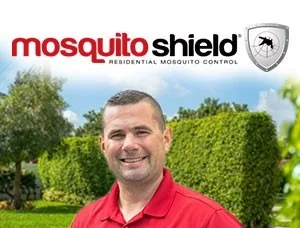
After nearly two decades in corporate finance (most of it at Chico's FAS, where he oversaw operations and finance for 1,000+ retail locations across the US and Canada) Eric Vincent earned his MBA from Rollins College and made a deliberate pivot into pest control, completing his Pest Control Technology degree at the University of Florida while building Mosquito Shield of Boca and Fort Lauderdale from the ground up. He holds five Florida state licenses including Certified Pest Control Operator (JF341961) and Public Health licensee (PH340549), and is currently partnered with Arkion Life Sciences on next-generation all-natural mosquito control research.