
Total: 7 to 14 days egg-to-adult at South Florida summer temperatures. No winter dormancy.
The Four Life Stages in South Florida Conditions
Female mosquitoes lay 50 to 300 eggs per batch, depending on species. Culex lay eggs on water surfaces in 'rafts' (floating clusters). Aedes lay eggs just above the waterline in containers, these eggs can survive completely dry for months and hatch when water returns. This delayed hatching is why a bromeliad or clogged gutter that was dry all week can suddenly produce adult mosquitoes after one rain event. The egg-desiccation resistance of Aedes aegypti and albopictus is a major challenge for South Florida mosquito control, you cannot eliminate the egg bank by draining containers once.
Larvae are aquatic. They live in water, hanging from the surface to breathe through a siphon tube. They go through four instars (growth stages), growing larger with each molt. In South Florida's warm water (80°F+), larval development completes in as little as 4 to 5 days during peak wet season; in cooler water (65 to 70°F in Broward's winter months), development may take 10 to 14 days. Larvae are vulnerable to biological controls during this stage: Bti (Mosquito Dunks) kills larvae; Gambusia fish eat them; Bacillus sphaericus targets Culex larvae in organically enriched water.
The pupal stage is a non-feeding transitional stage where the larva reorganizes into the adult form. Pupae are mobile and can swim rapidly to deeper water to escape predators. They do not eat during this stage. In warm South Florida water, pupation takes only 1 to 3 days. Pupae are not affected by Bti or most insecticides. This is the most treatment-resistant life stage. The pupa stage is a critical point where timing of source elimination or adult treatment can interrupt the cycle before new adults emerge.
Adults emerge from the water surface and can fly within minutes. Male mosquitoes live 1 to 2 weeks and feed only on nectar. Female mosquitoes require a blood meal to develop eggs, then typically live 2 to 8 weeks in the field (laboratory conditions can extend this to 2 months). Adult female Culex typically rest during the day in vegetation and host-seek at dusk. Adult female Aedes rest in shaded vegetation and host-seek throughout daylight hours. Both species rest in the same garden vegetation, which is the target zone for professional barrier spray application.
Ready to reclaim your yard? Free assessment, no contracts, plant-oil formula.
Frequently Asked Questions
Why does South Florida have mosquitoes year-round?
The mosquito life cycle requires three environmental conditions to operate: (1) temperatures above approximately 50°F for adult activity and above 60°F for larval development; (2) available breeding water; and (3) available hosts. South Florida provides all three conditions year-round: (1) TEMPERATURES: South Florida's annual low temperatures average 55 to 65°F in January (the coldest month) across Broward and Palm Beach counties. While some days drop briefly to the 40s, temperatures recover quickly and adult mosquitoes resume activity within hours of warming. Canal water temperatures in January remain above 65°F in most South Florida locations, warm enough for continuous Culex larval development. (2) BREEDING WATER: South Florida's 1,400+ miles of canals and the residential lake network provide permanent year-round standing water that supports continuous Culex breeding. Aedes aegypti breeding in container habitats (bromeliads, saucers, gutters) persists year-round because irrigation maintains container moisture even during the dry season (November to April). (3) HOSTS: Humans and wildlife hosts are year-round residents of South Florida. THE NORTHERN CONTRAST: In states with true winter (Minnesota, New York, Massachusetts), mosquito populations are extirpated or enter dormancy during cold months: water temperatures drop below Culex developmental thresholds, adults die, and only cold-resistant Aedes eggs survive in dormant form. South Florida never experiences this population reset. Each generation of Culex flows continuously into the next throughout the calendar year: there is no seasonal restart point. This is why South Florida requires year-round biweekly service rather than the seasonal spring-through-fall programs offered in northern markets.
How does knowing the mosquito life cycle help with control timing?
Understanding the life cycle explains why professional biweekly spray intervals are set the way they are: THE 7 to 14 DAY CYCLE: In South Florida's summer temperatures, the Culex mosquito can complete egg-to-adult development in as little as 7 days: egg hatches in 24 to 48 hours → larval development in 4 to 5 days at 85°F water → pupation in 1 to 2 days → adult emergence. Aedes development is similar. This means a site that produces breeding water today (a tipped bird bath, a rain-filled bucket) can produce biting adults in as little as 1 week. THE BIWEEKLY INTERVAL: Professional barrier spray every 10 to 17 days (biweekly scheduling) is calibrated to maintain continuous adult population knockdown during the period when new adults are constantly emerging from breeding sources. The residual effect of the MPB formula with Rain Shield polymer overlaps each service visit (new adults emerging from breeding sources and encountering treated vegetation are killed before they complete a blood meal and produce the next egg batch. WHAT HAPPENS WITHOUT CONTINUOUS COVERAGE: If spray residual lapses (rainy weather causing premature formula washoff, or a service interval longer than the residual period), a new cohort of adults from the breeding sources emerges into an untreated environment. In 7 to 14 days, those adults have completed multiple blood meals and produced the next generation) within 2 to 3 development cycles, the treated-property population can recover to pre-treatment density. This is why treatment consistency matters more than any individual spray visit.
Biweekly Spray, Calibrated to Interrupt the 7 to 14 Day South Florida Life Cycle
10 to 17 day residual from Rain Shield polymer overlaps each visit, adults emerging from breeding sources encounter treated vegetation before completing a blood meal. Continuous coverage through the generation cycle is how 80%+ population reduction builds by treatment 3 to 4. All-natural MPB formula. FL License JB313837.
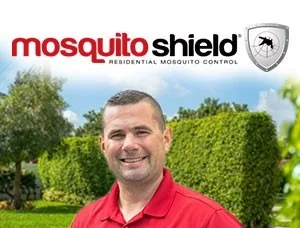
After nearly two decades in corporate finance (most of it at Chico's FAS, where he oversaw operations and finance for 1,000+ retail locations across the US and Canada) Eric Vincent earned his MBA from Rollins College and made a deliberate pivot into pest control, completing his Pest Control Technology degree at the University of Florida while building Mosquito Shield of Boca and Fort Lauderdale from the ground up. He holds five Florida state licenses including Certified Pest Control Operator (JF341961) and Public Health licensee (PH340549), and is currently partnered with Arkion Life Sciences on next-generation all-natural mosquito control research.