
American cockroach (palmetto bug) = outdoor roach that enters from outside → controlled by exterior perimeter spray. German cockroach = indoor roach that spreads through infested items → controlled by interior gel bait. Knowing which one you have determines the right treatment.
South Florida Cockroach Species
Ready to reclaim your yard? Free assessment, no contracts, plant-oil formula.
Frequently Asked Questions
What is a palmetto bug: is it different from a cockroach?
No ('palmetto bug' is a regional nickname for cockroaches, not a separate species. In Florida, the term most commonly refers to the American cockroach (Periplaneta americana), the large reddish-brown roach (1.5 to 2 inches) that lives outdoors in palms, mulch, and sewer systems and occasionally enters homes. The name comes from South Carolina's palmetto trees, where American cockroaches were historically common. In practice, Floridians also use 'palmetto bug' loosely for several other large roach species) the Florida woods cockroach, the smokybrown cockroach, and others. Entomologically, they're all cockroaches in the order Blattodea. The practical distinction that matters for control is not the nickname but the species: American cockroach and smokybrown cockroach are primarily outdoor insects that enter homes from the exterior (controlled by perimeter spray), while German cockroaches are indoor insects that enter through infested items brought into the home (controlled by gel bait treatment, not exterior spray).
Why do palmetto bugs come inside my South Florida home?
American cockroaches (palmetto bugs) enter South Florida homes primarily in response to three conditions: (1) Moisture: American cockroaches are moisture-seeking insects. During dry periods or when outdoor conditions shift, they migrate toward humid interior environments, particularly bathrooms, kitchens, and laundry rooms where humidity concentrates. Leaking pipes, poor drainage near the foundation, and condensation around AC units are entry attractants. (2) Heat and light, during warm wet season nights, American cockroaches are active outdoors and are attracted to indoor lighting. They enter through any gap they can find: under doors without proper sweeps, through plumbing penetrations, around AC lines, through unsealed cracks in foundations. (3) Flooding or heavy rain: heavy rain and flooding drive American cockroaches out of their normal outdoor habitats (soil, mulch, tree hollows, sewer systems). Post-rain events often produce a surge in roach entry attempts. Important note: seeing a large cockroach (palmetto bug) in a South Florida home is NOT necessarily a sign of an unsanitary home. American cockroaches live outdoors throughout South Florida regardless of home cleanliness. They enter primarily through structural gaps rather than being attracted to poor sanitation (though food and grease build-up indoors can encourage them to stay once inside).
What is the best way to get rid of palmetto bugs in South Florida?
Palmetto bug (American cockroach) control in South Florida centers on exterior perimeter spray. Because these are outdoor insects that enter from outside: (1) Professional perimeter barrier spray: a professional exterior perimeter treatment targets American cockroaches, smokybrown cockroaches, and other outdoor-originating roach species where they live and travel: around the foundation, under mulch and leaf litter, around entry points (door thresholds, plumbing penetrations, utility gaps), and in the 3 to 6 foot band around the home's perimeter. This is the primary and most effective control for palmetto bug pressure. (2) Exclusion, seal structural entry points. Install door sweeps on all exterior doors. Seal gaps around pipes, AC lines, and electrical penetrations. Screen attic vents. Reduce entry opportunities. (3) Moisture reduction: fix dripping outdoor faucets, improve foundation drainage, reduce irrigation near foundation, ensure AC condensate drains properly away from the house. (4) Mulch management, pull mulch back from the foundation a minimum of 12 to 18 inches. Deep mulch directly against the foundation creates the moist, protected habitat American cockroaches prefer. (5) Lighting: switch outdoor lighting near entry doors to yellow-spectrum bulbs, which are less attractive to insects than white/blue lights. What does NOT work: Interior gel bait treatment (used for German cockroaches) is largely ineffective for American cockroaches. They don't establish indoor feeding territories the same way. The answer for palmetto bugs is controlling them outside before they enter, not treating the interior after they're already in.
Does Mosquito Shield treat for cockroaches?
Yes: our Pest Shield perimeter service covers cockroaches along with ants, spiders, silverfish, and other perimeter-invading pests. Pest Shield is an exterior perimeter spray applied every 60 to 75 days to the foundation band and entry points around your home. It's the professional treatment that controls the outdoor-originating roach species (American cockroach and smokybrown cockroach, both commonly called 'palmetto bugs' in South Florida). For the German cockroach, the small indoor kitchen/bathroom roach, contact us for a separate assessment. German roach treatment is interior-focused gel bait work, which is different from the exterior perimeter service. If you're not sure which type of roach you have, call or text a photo to 561-443-3333 and we can identify the species and recommend the right treatment approach.
I just saw a huge cockroach fly across my living room. What is it?
If a large (1.5 inch+) reddish-brown cockroach flew or glided across your room, it's almost certainly an American cockroach (palmetto bug) or smokybrown cockroach: both are common in South Florida and both can fly, though they do so rarely and usually only when startled or at high temperatures. The characteristic features: (1) American cockroach: reddish-brown, 1.5 to 2 inches, with a distinctive pale yellow figure-8 pattern on the pronotum (the shield-like plate behind the head). Very common. (2) Smokybrown cockroach: uniformly dark mahogany brown, 1.25 to 1.5 inches, no pale markings. Common in tree-canopy neighborhoods throughout Fort Lauderdale, Coral Springs, and Boca Raton. More of a flier than the American cockroach, often attracted to lights and enters through upper-level gaps. Both species live outdoors and enter homes opportunistically. A single sighting does not mean you have an infestation. It does indicate a structural entry point and potentially active outdoor pressure around the home. If you see them repeatedly, that's a sign the outdoor population is high enough to warrant professional perimeter treatment.
Pest Shield Perimeter Control - Roaches, Ants, Spiders & More
Exterior perimeter spray every 60 to 75 days targets American cockroaches, smokybrown cockroaches, ants, spiders, silverfish, and other perimeter-invading pests before they enter your home. FL License JB313837.
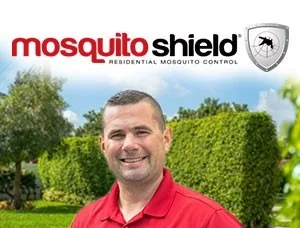
After nearly two decades in corporate finance (most of it at Chico's FAS, where he oversaw operations and finance for 1,000+ retail locations across the US and Canada) Eric Vincent earned his MBA from Rollins College and made a deliberate pivot into pest control, completing his Pest Control Technology degree at the University of Florida while building Mosquito Shield of Boca and Fort Lauderdale from the ground up. He holds five Florida state licenses including Certified Pest Control Operator (JF341961) and Public Health licensee (PH340549), and is currently partnered with Arkion Life Sciences on next-generation all-natural mosquito control research.