South Florida Termite Species
Ready to reclaim your yard? Free assessment, no contracts, plant-oil formula.
Frequently Asked Questions
What does a termite swarm look like, and should I panic?
A termite swarm is a mass flight of winged reproductive termites (alates) leaving the colony to find mates and start new colonies. What it looks like: (1) Sudden appearance of dozens to thousands of small winged insects, typically near a light source or in a particular area of the home. (2) Wings shed immediately after flight: piles of discarded wings near windows, doors, or the swarm site are the most distinctive indicator. Termite wings are equal in length (ant swarmers have unequal wings, longer front wings). (3) The swarmers themselves are temporary. They die within hours if they cannot find suitable conditions. The swarm itself is not damaging to your home. The danger is not the swarm. It is the colony that produced the swarm. A swarm indicates an established colony large enough to reproduce. Eastern subterranean colonies take 3 to 5 years to produce a swarm; Formosan colonies can swarm sooner when conditions are right. What to do: (1) Capture several swarmers in a sealed plastic bag or jar, preserve them for identification. Photo them first. (2) Note the time and date, daytime January to March swarms suggest Eastern subterranean; evening April to June swarms suggest Formosan or Asian subterranean. (3) Call for a professional inspection, a swarm indicates an active colony somewhere in or near your structure. The colony location needs to be found and treated. (4) Don't panic and don't spray consumer pesticide on the swarmers, killing the swarmers doesn't affect the colony. They are the reproductive population, not the workers causing damage. The damage is being done by the millions of workers that never swarm.
What's the difference between termite monitoring stations and liquid treatment, which is better?
Both monitoring stations and liquid treatment are effective termite control strategies for South Florida, but they work differently and have distinct advantages: MONITORING STATION NETWORKS (Sentricon, Trelona, etc.): How it works: Stakes with cellulose bait matrices are installed around the property perimeter at regular intervals. Worker termites foraging from the colony encounter the bait stations, begin feeding on the cellulose bait, and carry toxic bait ingredients back to the colony. The active ingredient (typically noviflumuron or indoxacarb) is a chitin synthesis inhibitor. It doesn't kill immediately but prevents molting, eventually eliminating the entire colony including the queen. Advantages: (1) Eliminates the entire colony rather than creating a barrier. (2) Minimal environmental footprint: bait is applied in small quantities in discrete stations, not broadcast soil treatment. (3) Provides ongoing monitoring between visits: technician inspects stations during service visits and can detect new activity at any station. (4) Effective for Formosan and Asian subterranean, which can breach liquid barriers. (5) Preferred for structures near water, sensitive landscaping, or where liquid treatment trenching is impractical. LIQUID SOIL TREATMENT (Termidor, Altriset, etc.): How it works: A continuous treated zone is created in the soil around the foundation by trenching and treating at the foundation perimeter. Worker termites crossing the treated soil are killed or transfer the treatment to nestmates (for Termidor's transfer effect). Advantages: (1) Immediate protection: treated zone is in place from application day. (2) Effective perimeter protection against new colony expansion from neighboring properties. (3) Lower per-treatment cost for simple structures. SOUTH FLORIDA RECOMMENDATION: Monitoring station program with ongoing inspection is the preferred approach for most South Florida homes, especially in Formosan-active areas (Broward County has significant Formosan populations). The combination approach, monitoring stations plus liquid spot treatment at known activity, provides the most comprehensive protection.
How do I know if I have termites right now even without a swarm?
Termites are active year-round in South Florida and the vast majority of colonies never produce a visible swarm before causing significant damage. Signs of active termite presence without swarming: (1) MUD TUBES: Eastern, Formosan, and Asian subterranean termites travel from soil to wood through protective mud tubes: pencil-width to finger-width tubes of soil and excrement on foundation walls, piers, the outside of exterior walls, and interior wall surfaces near the floor. These are the clearest indicator of subterranean termite activity. Break a mud tube. If it is rebuilt within a few days, the colony is active. (2) HOLLOW-SOUNDING WOOD: Tap wood trim, door frames, baseboards, and floor boards with a coin or screwdriver handle. Hollow thumping vs. solid sounds can indicate internal wood consumption. (3) TIGHT-FITTING DOORS OR WINDOWS: Termite feeding and associated moisture damage can cause wood to swell, making doors and windows difficult to operate. This is a late-stage indicator: the damage is already significant. (4) VISIBLE DAMAGE: Small pinholes in wood surfaces, damaged wood with wavy surface patterns or channels visible when broken, or wood that crumbles with light pressure. (5) FORMOSAN CARTON MATERIAL: Formosan termites often construct carton (chewed wood, soil, and excrement mixed into a cement-like material) in wall voids and structural members. When found during renovation, it indicates Formosan infestation. Annual professional termite inspection is the standard in South Florida. Professional inspectors find activity that homeowners miss: particularly in attic spaces, subfloor areas, and wall voids that are not accessible from the living area.
What is the subterranean termite monitoring service that Mosquito Shield offers?
Our subterranean termite monitoring station service provides ongoing termite monitoring for South Florida homes and businesses through a network of in-ground monitoring stations installed at the property perimeter. What the service includes: (1) INITIAL INSTALLATION: Monitoring stations (with cellulose wood matrix or bait) are installed in the soil around the property perimeter at regular intervals. The number of stations depends on the property size and perimeter length, typically one station every 8 to 10 linear feet of perimeter for standard residential properties. (2) REGULAR INSPECTION: Service visits include inspection of all stations for termite activity, checking for tunneling, feeding damage to the station wood matrix, or termite presence at any station. (3) BAIT PLACEMENT ON ACTIVITY: When termite activity is detected at a monitoring station, the monitoring matrix is replaced with a bait matrix containing chitin synthesis inhibitor. Worker termites feed on the bait and transfer it to the colony. Station inspections are increased in frequency when active bait feeding is ongoing. (4) ONGOING MONITORING: After colony elimination is confirmed (no more activity at bait stations), the stations return to monitoring mode for detection of new colony encroachment from neighboring properties. Service is licensed under FL License JB313837. Call 561-443-3333 or request a free property assessment to discuss monitoring station installation for your home.
Subterranean Termite Monitoring Stations, Ongoing Protection for South Florida Homes
In-ground monitoring station network with professional inspection. Detects Formosan, Eastern, and Asian subterranean termite activity before structural damage occurs. FL License JB313837, Wood Destroying Organisms category.
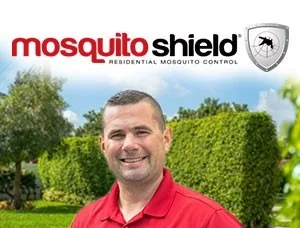
After nearly two decades in corporate finance (most of it at Chico's FAS, where he oversaw operations and finance for 1,000+ retail locations across the US and Canada) Eric Vincent earned his MBA from Rollins College and made a deliberate pivot into pest control, completing his Pest Control Technology degree at the University of Florida while building Mosquito Shield of Boca and Fort Lauderdale from the ground up. He holds five Florida state licenses including Certified Pest Control Operator (JF341961) and Public Health licensee (PH340549), and is currently partnered with Arkion Life Sciences on next-generation all-natural mosquito control research.